
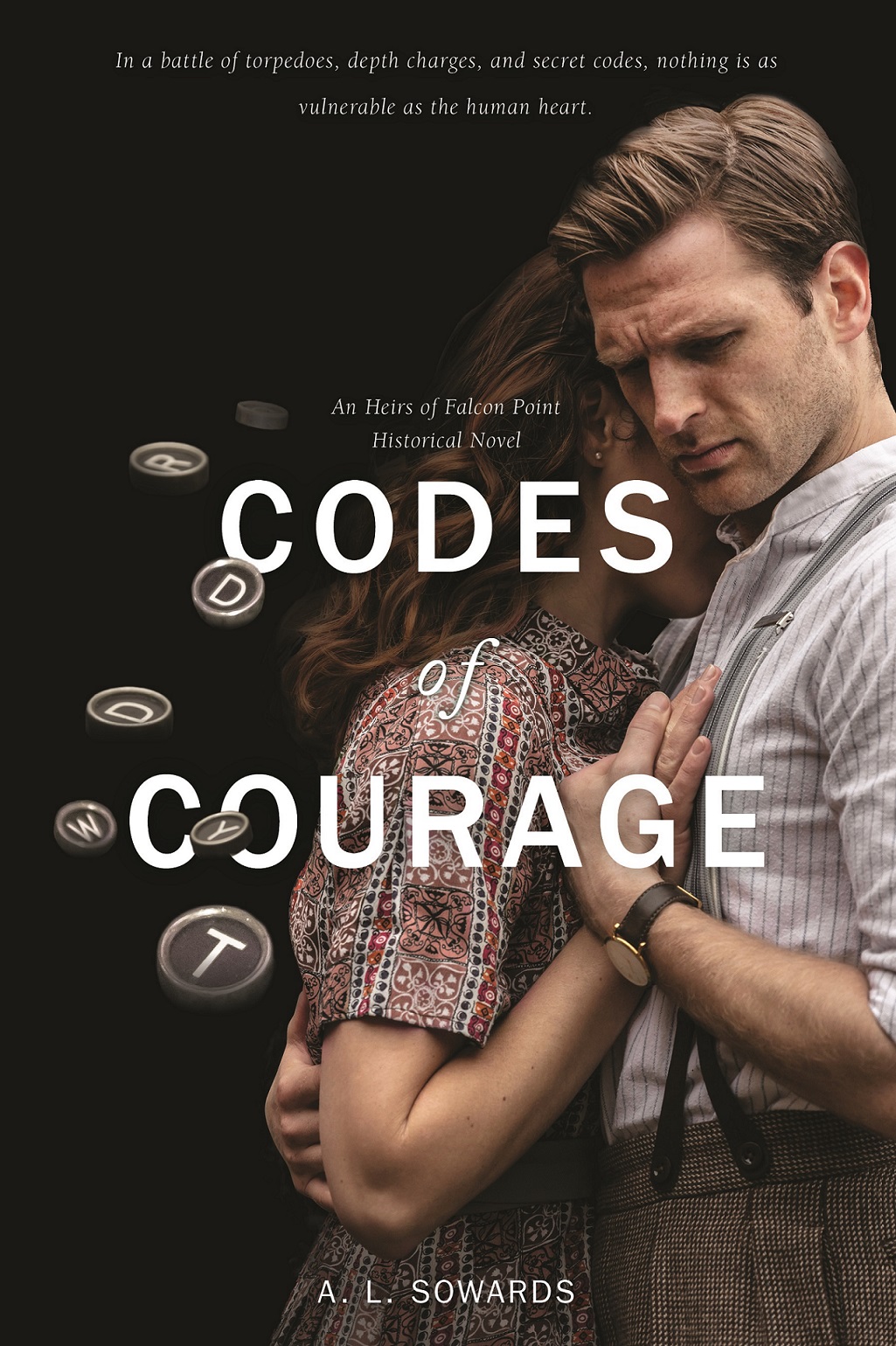
I first learned about Enigma machines when my high school history teacher recommended I read The Ultra Secret by F. W. Winterbotham. I’ve been intrigued ever since and found it particularly satisfying to include a part of history that I have loved for so long in this novel. Though many books have been published about British and other Allied efforts to break German codes during the war, The Ultra Secret was one of the first to break the previously classified information and would have been the book Millie, her uncle, and Rolf all read in the 1970s.
When I began planning this book, working off what was published in Heirs of Falcon Point, I intended to place Karl Lang in the Royal Navy fairly quickly after his escape from Austria. Then I learned that the Royal Navy did not accept foreign-born recruits until somewhat later in the war. Foreigners were allowed into Auxiliary Military Pioneer Corps in the British Army, so for a day or so, I planned to have Karl join the Pioneer Corps and evacuate Dunkirk with some of the companies who served there. Then I discovered that the Auxiliary Military Pioneer Corps only accepted recruits aged twenty to forty-five, leaving me, and Karl, with few options, except to join the Merchant Navy, which included a great variety of men of assorted ages and nationalities.
I’m glad my research led to the world of tramp steamers and tankers. Though often overlooked, their contribution to the Second World War was enormous, and I feel that their inclusion in a novel about the fight against the U-boats gives readers a better view of the dangers, risks, and high stakes this part of the war included. Over 36,000 sailors in the British Merchant Navy lost their lives during the war, and a further 10,000 were wounded or taken prisoner. Despite the obstacles they faced, early in the war, pay for merchant sailors ended when a ship was sunk, though later this was adjusted.
Karl’s eventual enlistment in the Royal Navy would have been unusual but
not unheard of. Approximately 10,000 refugees and immigrants from Germany and Austria served in the British armed forces during the Second World War. The bulk of those men served in the army rather than the navy or air force, but enemy aliens swore allegiance to the king and appeared in all branches of the British military by war’s end.
The SS Gracechurch and its crew are fictional, but the SS Matheran, SS
Bilderdijk, SS Loch Lomond, SS Uganda, and HMS Jason are all from history,
and the various sinkings and rescues for convoy HX-79 on October 19 and
20, 1940, are based on historical documentation. The SS Hillingdon, the SS
Minstrel, and the Torlin Line are all fictional.
The U-100, her victories in October 1940, and her captain, Kapitänleutnant
Joachim Schepke, are pulled from history. Rolf’s inclusion on the U-100 is,
however, fictional. There was no U-115 during WWII, but her crew and
wartime experiences are patterned after what was typical for U-boats at the
time. U-690 is used fictitiously in this novel. The real U-690 was ordered
but canceled before work started in favor of a different U-boat type. Rolf’s
survival through the destruction of two U-boats was possible but, admittedly, a statistical anomaly. Roughly three-fourths of the men who served on U-boats during the Second World War perished (some sources say it was closer to four-fifths). For comparison purposes, the death rate for air crews in the Royal Air Force bomber command was approximately 44 percent, and numbers for sailors and officers in the Royal Navy was between 6 and 7 percent.
The HMS Fireweed and the HMS Lily are fictional, though corvettes were
frequently named after flowers. Likewise, the destroyers HMS Achilles and the HMS Kadesh were created for storytelling purposes rather than pulled from history.
Sometimes the breaking of German naval codes by workers at Bletchley
Park is presented as a single event, but as is so often the case in history, the real story is more complicated. Every time a setting changed for one of the multiple naval codes, that code had to be broken again. The codebreaking efforts might never have succeeded had it not been for help received from events at sea. The Fireweed, of course, wasn’t really involved in any of the historical “code pinches.” I patterned those fictional events mostly after the HMS Petard’s seizure of U-559 and a U.S. Navy task force’s seizure of U-505.
The capture of the U-559 on October 30, 1942, was perhaps the most
significant code pinch of the war, leading directly to the end of a ten-and-a-half-month-long blackout on naval Enigma. Lieutenant Francis Anthony Blair Fasson, Able Seaman Colin Grazier, asdic operator Kenneth Lacroix, and sixteen-year-old canteen assistant Tommy Brown of the HMS Petard swam from their destroyer to the sinking U-boat and recovered invaluable material.
When the U-559 sank, it took Fasson and Grazier with it. Brown, who had
lied about his age in order to go to sea, was pulled under along with the U-559 but resurfaced to be picked up by the Petard’s whaler. Though Brown survived the incident on the U-559, he did not live to see the end of the war. He died trying to save his siblings when a house fire broke out while he was home on leave, leaving Lacroix the sole survivor of the men who braved the sinking U-559.
The U-505 was captured on June 4, 1944, by a U.S. Navy task force. The crewmen of the U-505 expected it to sink before capture because one of
them had removed the sea strainer before abandoning ship. But one of the
boarding party found and replaced the strainer, covering the drain and saving the ship, which is today in the Chicago Museum of Science and Industry. The U-505’s capture yielded two Enigma machines, several codebooks, sea charts, and other documents and equipment. Like Rolf, the U-505’s crew was placed under tight security, not in accord with the Geneva Conventions, in order to maintain secrecy regarding the capture.
Other significant naval events helped the codebreaking efforts at Bletchley
Park. In February 1940, three Enigma rotors were captured from a survivor of the U-33 who had been told to drop them into the sea after abandoning ship. In all the confusion, he left them in his pocket, where the British found them. More information was captured from the German trawler Polares in April of that same year. In March 1941, British commandos in the Lofoten Islands of Norway recovered Enigma rotor wheels and codebooks from the German trawler Krebs. An expedition was undertaken in May 1941 with the express intention of raiding the German weather ship München for Enigma materials, and it was successful. That same month, further materials, including an intact Enigma machine, were taken from the U-110 when she was damaged and her crew had abandoned ship. Another German weather ship, the Lauenburg, was targeted at the end of June and yielded Enigma settings for June and July of 1941. And earlier in June,
materials were taken from the Gedania. Further incidents leading to the capture of coding documents and equipment include a group from the HMS Paladin, a British destroyer, boarding the U-205 in February 1943, and a group from HMCS Chilliwack, a Canadian corvette, boarding the U-744 in March 1944.
I hope readers will forgive me for stretching history just a bit when it comes
to Millie’s work in Bletchley Park. By the end of the war, Americans working
alongside their British counterparts at Bletchley Park was common and routine, but I was unable to find historical examples of Americans working there in autumn 1940, when Millie begins her work. Much recruitment of Bletchley Park workers, especially in the beginning stages of the war, was done by word-of-mouth through professional and social networks, so I felt it plausible that someone with the right skill set—and with a British admiral for an uncle—might be offered employment there, even if she was only half British.
Likewise, Millie would have been bending the rules to give Karl her billet’s
address so he could send telegrams after their initial meeting at Fenny Stratford. Workers at Bletchley Park were supposed to have mail sent through the Foreign Office. One of my research books said this system broke down when someone tried to send a grand piano via the Foreign Office in London, and another cited examples of high-ranking siblings trying to visit codebreakers at BP and being turned away at the gate. Overall, security at Bletchley Park was extraordinary,given how many people worked there.
Other details of Bletchley Park I have kept as close to the truth as possible,
including the billeting system, the rotating watches, complaints about the
cafeteria, and details of the manor and train station. Several real people from Bletchley Park’s history appear on the pages of this book. Commander Travis was BP’s deputy director at the time Millie would have met him, and asking new employees to sign the Official Secrets Act was among his duties. Josh Cooper’s activity of looking through items gathered from shot-down airmen came from my research, but not, of course, with Millie as a translator. Alan Turing was a key Bletchley Park cryptanalyst. Most of his dialog in this novel is fictional (with the exception of the “maybe a pinch, maybe the Poles” line), but his stutter, nail biting, personal grooming standards, details of his bicycle riding with a broken chain and a gas mask, and habit of chaining his tea mug to the radiator have been documented.
Thank you to all the readers who read Heirs of Falcon Point and wanted to
know more about Karl, Ingrid, and Anna Lang. If you enjoyed this book, I
would be very grateful for your review on websites where books are sold or
discussed, or your recommendation in person or via social media.
Special thanks goes to Paige Edwards, Kathi Oram Peterson, Bev Walkling,
and Ron Machado for reading early versions of this manuscript and offering suggestions. Thank you to Melanie Grant for brainstorming with me before I drafted and then being a test reader. Thanks to Traci, Sian, and Paige for pulling me into the Falcon Point world—what a journey it has been! Also, a big thanks to the team at Covenant Communications. The process of getting a book from a document on my computer to a polished novel in multiple formats involves the talents and hard work of a large team, and I’m grateful for all of their efforts. Thank you especially to my editor, Samantha Millburn.
 A. L. Sowards